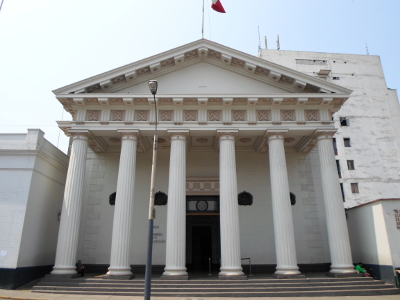
Museum of the Inquisition


January 9, 1570 the Peruvian Inquisition began this like the Spanish Inquisition was an institution run by the church which sought to remove all those were guilty or supposedly guilty of crimes against the Catholic Church like heresy, witchcraft and sorcery. The main targets were people of lower class such as mestizos, women, Jews and people of African descent. 


The history of these dark times in Lima can be seen in the museum located just off Abancay Avenue and is called Museo del Congreso y de la Inquisición (Museum of Congress and Inquisition). This building was the seat of the Peruvian Inquisition from 1584 to 1810, the Peruvian Inquisition came to an end in 1813 by virtue of a Cortes decree however it came back to a lesser degree in 1815 till its final demise shortly after. 
The role of this building changed many times before it opened its doors to the public as museum on the 26th of July 1968.  This museum is open from Monday to Sunday 9 am till 5 pm and there is a free guided tour. So what will you expect to find here?


Well as soon as you enter the museum you will be taken into the “Hearing Room” here prisoners were sentenced and after this building changed roles it became a seat of national meetings. One of the most iconic pieces of this room in is the ceiling which is all hand crafted from 30 000 pieces of mahogany. Now as you travel through the different rooms you will see a sudden changes that change I mean from the bureaucratic setting to the grim. 


You will be taken through rooms that display numerous original contraptions that were used to the extract confessions from the prisoners that were sent there.  Now it is said that torture was not as brutal as it is played out to be, in many cases a doctor was present, no blood was allowed to be spilt and each session was limited to 15 minutes. 


Now a warning for tall people like myself I found myself crouching through the area of the old dungeons so be careful with your head, this place displays two kinds of dungeons ones that are open and were for prisoners that were “fairly” judged and there are the secret ones that you can still see today these were for prisoners who really did not know why they were imprisoned, some of these prisoners were held for weeks, month and even years.
Another strange and usual piece of this museum is the pre-Hispanic aqueduct that was discovered and is located in a small room.


This museum is not all about the grim history of torture but within the same museum is the history of congress. Here you will be taken on a tour which will explain how the political scene of Peru changed through the years to the present moment.  


I would recommend this museum to anyone it is free and it is well worth the time and you can take all the pictures you wish here. 

Hidden gems of Peru

Peru has many sites that you can visit like Machu Picchu, Cusco and Lima however, there are many hidden gems within a county and I wish to give you some insights of these places below.


If you travel to Amazonas in Peru, you cannot miss Kuelap the ancient ruins of a fortress that once inhabited by the Chachapoyas (7th or 8th century) an Andean culture going back before the Incas however, they would be conquered and ruled by the Incas and by the 18th century they would be completely devastated.
The Kuelap is situated 3000 metres above sea level and in some parts of this ancient fort the walls can reach 19 metres high and beyond these limestone walls lies the inner city that contains around 400 stone structures most of which are now destroyed and only the bases of the contracts can be seen.


The purpose of this structure is still being asked and some suggest it was to protect from hostile outsider, a place of refuge or a place of aristocracy.
Kuelap was brought to the world’s attention in 1843 by Juan Crisosotomo Nieto, this place like Machu Picchu was already know to the indigenous people of the area.
To get to this place it is best that you travel to the town Chachapoya and from there Kuelap is 3 hours away by road additionally this place can be reached from Chiclayo however, this is an 11-hour road trip along bumpy roads.


Another place that is not well known or exploited by tourists is the Pre-Incan ruins of Marcahuamachuco which is locate in the La Libertad region of Peru. Built in 400 AD to 1000 AD no one really knows what civilization built this and it is said it had a profound influence on the Huari and Inca cultures especially in architecture.  The function of the site, although not fully clear, was as a religious and political center, including turning into a burial site in its later stages. 


This place is full of distinctive double-walled circular structures and large stone structures.
Due to the deterioration of this place the Global Heritage Fund with the aim of restoration, preservation, and sustainable tourism.
You can get to this place you first need to go to Trujillo and from there you can take a taxi or a bus that will travel three and half hours to the location.


Now, everyone may have seen Machu Picchu or plan to go to it however, there is an another place
that is similar known as Choquequirao located around the Willkapampa mountain range in the La Convención Province of the Cusco Region above the valley of river Apurímac. This is also an Incan site and is located 3,000 m above sea level. This place is also significant because it was the last refuge of Manco Inca Yupanqui when his siege on Cusco failed in 1535.
Like Machu Picchu this place contains many stone buildings and terraces but due to the remoteness of this place it is largely forgotten about.
The site was probably first visited by Juan Arias Díaz in 1710 but the first written reference to the site was made by Cosme Bueno in 1768 but was largely ignored.  In 1834 Eugene de Santiges rediscovered the site. In 1837 Leonce Agrand mapped the site for the first time, but his maps were forgotten. 


When Hiram Bingham, the discoverer of Machu Picchu, visited Choquequirao in 1909 the site gained more attention. It was in the 1970´s when excavation of the site began.
Treks to Choquequirao start from the village of Cachora, which is a 4-5 hour drive west of Cusco city. The route usually goes from Cachora through the Apuramic Valley to Chiquisca where most trekkers overnight. From Chiquisca the trail continues along the Apurimac River before ascending to Santa Rosa and then onto Marampata. 


Choquequirao is a little way on from Marampata. The trail to Choquequirao is unpermitted and can be completed unsupported, however most trekkers join organised tours that include a guide, camping equipment, mules and muleteers to carry gear and a cook to prepare food. From Choquequirao it is possible to continue hiking to Machu Picchu. Choquequirao trek itineraries to Machu Picchu vary. Most treks range from 7-day to 11-day hikes, and involve going over the Yanama Pass, which at 4,668m is the highest point on the trek. You will need to be well acclimatized for this trek to avoid altitude sickness.
It was revealed that the regional government is planning to invest $50m but is yet to be finalized.


Definitely there are much more sites to visit than the ones you already know :)  

Plaza Mayor of Lima


In the heart of Lima lies the Plaza Mayor this a large square and really is where Lima began, in 1523 King Charles I of Spain mandated  Procedures for the creation of cities in the New World stating that cites should be founded with a large square and grow outwards. So what will you find around this square? 


Firstly you will find the Government Palace of Peru and is one place you cannot miss. On the 18 thof January 1535 Francisco Pizarro with twelve others founded the city of Lima and with that they started work on the Government Palace which was built during the same year. At the time this building only stood two-story high and was made of adobe.   


The Palace was built over a huaca (Huacas are pre-Colombian sacred sites) that had a shrine to Taulichusco the last official to the Inca Empire in the Rimac Valley.   
This building and its location marks two historical moments in Peru, on June 26 1541 the conqueror of Peru Francisco Pizarro was assassinated in the Palace by Diego de Almagro II and on the 28 July 1821 General Jose San Martin declared independence.    
During many years this building has been modified and changed but on top of this the building has been ransacked three times (The   Almagristas - those involved in the killing of Pizarro, Chileans during the War of the Pacific- April 5, 1879 – October 20, 1883 and by the Pierolistas during the Peruvian Civil War 1894 to 1895), it has also suffered damage from approximately six earthquakes and three fires.  


Due to one fire in 1921 the building was severely damaged so the presidents then Augusto B. Leguía chose French architect Claudio Sahut to help rebuild it however, Leguía was ousted and during the time of political turmoil some parts were built but during the years of President Oscar R. Benavides the building was completed under the supervision of Ricardo de Jaxa Malachowski a Polish/Peruvian architect. 


You will then find another large building in the square known as The Basilica Cathedral of Lima (Basílica de Nuestra Señora de la Merced) which was built in 1538 however; the first Cathedral was small and rustic but during many years more work and investment expanded the Cathedral till 1609 when an earthquake badly damaged it. 


Damage and restoration was a continuous right till 1940 this however gave the Cathedral a unique architectural design; here you can find elements of baroque, Gothic and Neoclassic pieces.  Also within this place you can find the final resting place of Francisco Pizarro. 
Located next to the Cathedral is the Archbishop’s Palace of Lima; this is not the originally building. The original building was built 1548 however it was demolished and a new building was erected on December 8th 1924 and was designed by Ricardo de Jaxa Malachowski. 


This new building served for a little while as the first police headquarters and jail of Lima but Pope Paul III designated this as a holy site and this is when it became the headquarters of the Catholic Church in Lima and hosts the office to the Archbishop of Lima who currently is Juan Luis Cipriani. What you will also notice is this building is a prime example of Neo-colonial architecture that developed in Lima during the early twentieth century.  


Now looking around you will eventually find Municipal Palace of Lima just across the plaza from the Cathedral.  As with many building around the plaza this building to has been modified and changed over many years and does not look like the original Municipal Palace of Lima.  The original building was built in 1549 but due to many earthquakes 1746 and fires it was modified many times.  Although the building was damaged by fire the “Charter of Foundation of Lima” signed by Francisco Pizarro and the “Declaration of Independence” were unaffected, these documents can still be found today in the library of this Palace.  Once again we can find that Ricardo de Jaxa Malachowski lead the project and helped in the construction of a new building and was completed in 1944 and was inaugurated on 2nd of July 1944.  The municipal library within the building was opened later in 1945. 


Finally you will find a building known as El Club de Union which is an non-profit civil association that was founded on the 10th  October 1868 some of the founding members would go on to fighting in the War of the Pacific people like, Miguel Grau, Alfonso Urgarte and Francisco Bolognesi.  


Now for a little extra information right in the centre of the Plaza you will find a large fountain this fountain is also the product of many changes and it was not always like that. 
The original was constructed under the orders of Virrey Francisco de Toledo in 1578 and when constructed the fountain had a sphere on top and not the angel centrepiece you see today and this held the coats of arms of Lima.  In 1651 this was replaced under Virrey Garcia Sarmiento de Sotomayo and the angel centrepiece was placed on top however in 1900 the mayor of Lima Federico Elguera ordered the restoration of the plaza this included the fountain but when the angel was taken down it was broken by mistake. It was not until 1997 that the angel centrepiece was replaced this was decided under the suggestions of a Peruvian politician called Alberto Andrade; restoration of the fountain was undertaken by architect Jorge Orrego Vargas. The centrepiece is also known as “Angel de La Fama”, “Fama” is known in Greek/Roman mythology as a goddess “Fama”when translated to English is Pheme . 


As walk around the center of Lima you will find a lot of different building some going back to the colonial days and some that were built a little later on however, all show an expansive history Lima and the preservation of these buildings is important.  I recommend anyone going to visit these places to read about their history first and you will be truly amazed when you get to them.  

Peruvian Military Parade

Happy Independence Day


29th of July is an important public holiday which marks the independence of Peru (known as Fiestas Patrias) which was declared in 1821. During the days before this event takes place you will see many Peruvian flags being put out during this time businesses, homes and schools.  


This is obligatory and some districts of Lima will impose a fine for those that do not fly the flag. 
The first day of this event the 28th is started by a mass called Te Deum conducted by the Archbishop of Lima this is usually around 9 am. 

(Ollanta Humala, current president of Perú and his ministers) 


It is also tradition that on this day the Peruvian president must address the nation about the nation’s progress to that point; this was established by the liberator Jose de San Martin. Also.


On the 29th there is a large military parade that passes through Lima Downtown where Peru shows its military hardware and soldiers, these soldiers are from all kinds of divisions and from all over the country.  There is a military fly over with planes and helicopters involved. 


Now this event is not only military this is also to pay respects to police force and fire fighters even on occasion the police K9 unit passes and the dogs are always willing to put on a show for their fans, also this year the students of the program "Beca 18" were part of the parade (social program run by the government that seeks to help young people that can't afford to pay for an university or institute). It can get very busy in this part of Lima on this day so if you do not wish to watch it in person the parade will be displayed on many TV channels.

Overall, the most important is to share a moment with your family,friends or as a foreigner just admire and learn a bit more about Peruvian history! 

Groot in Peru


Groot has touched down in Perú! in Cuzco to be precise. This sculpture was created by students from ""Escuela de Bellas Artes de Cusco" (Diego Quispe Tito)   and it's made of recycle materials.  Although this piece of art was not display in the parade of the institute it was given recognition by the director of the movie (James Gun) who posted pictures on his facebook and twitter.


Sadly a lot of art work like this are lost; however, due to the popularity of this piece it will be preserved and put on display in the gallery of the institution where it was made.


To promote tourism, Groot is now available to the public, you can find it in Checacupe, 80 Km from Cusco....don't miss the opportunity to visit it when you're around!


Photo credit to: Cusco desde El Lente de Mi Camara